
#176 How does the memory work in ChatGBT

Did you know ChatGPT can remember thousands of tokens? This lets it have deep and meaningful conversations. We'll explore how ChatGPT's memory works, including its architecture and functions.

Key Takeaways
ChatGPT keeps a memory of thousands of tokens, making conversations rich and meaningful.
Its memory system has parts for processing, storing, and managing chat info.
ChatGPT remembers the context, follows the flow of info, and switches between topics smoothly.
Even though ChatGPT's memory is vast, it's not endless. It has limits in storing and processing tokens.
Using prompts well can help make the most of ChatGPT's memory and conversation skills.


Understanding ChatGPT's Memory Architecture
To fully understand ChatGPT, we must explore its memory system. At its core, ChatGPT has a complex memory setup. It's designed to store, process, and recall information efficiently.
Short-term Conversational Memory Components
ChatGPT's memory has two main parts: short-term conversational memory and long-term knowledge retention. The short-term memory helps keep conversations flowing smoothly. The long-term memory lets ChatGPT access a vast amount of information for detailed answers.
Token-based Memory Limitations
ChatGPT's memory works on a token-based system. This means it can only handle a certain number of tokens at a time. This limits how long and complex conversations can be. But it also makes ChatGPT quick and flexible in responding to users.
Memory Processing Mechanisms
The tech behind ChatGPT's memory is advanced. It uses natural language processing (NLP) and machine learning. These tools help ChatGPT understand and remember the details of conversations. This way, it can give answers that fit the user's specific needs.
Learning about ChatGPT's memory architecture helps us see its amazing capabilities. It shows how ChatGPT is changing the game in chatgpt memory retention, chatgpt knowledge retention, and chatgpt session memory.
ChatGPT Memory: Core Functions and Capabilities
ChatGPT's memory is key to its amazing chat skills. It keeps a ChatGPT conversation history to understand and answer questions well. This ChatGPT context awareness lets it keep conversations going, remembering important details for better responses.
ChatGPT tracks your chat flow. It records your dialogue, saving topics, questions, and preferences. This history helps ChatGPT give answers that fit the conversation perfectly.
ChatGPT also gets the big picture of your chat. It looks at how different parts of the conversation connect. This lets it guess your feelings and what you mean, making its answers more real and caring.
Core Memory FunctionsKey CapabilitiesConversation History TrackingMaintains a detailed record of the dialogue, enabling coherent responses and continuity. Contextual UnderstandingAnalyzes the broader context of the conversation, allowing for more insightful and appropriate responses. Dynamic Recall and Response GenerationLeverages the stored information to generate relevant and engaging responses in real-time.
ChatGPT's memory makes it great at chatting. It offers a natural, smart, and personal experience. As AI chat gets better, ChatGPT shows us what's possible in talking to machines.

"The memory capabilities of ChatGPT are truly remarkable, enabling it to maintain coherent and context-aware conversations that feel almost human-like."
Context Retention in Conversational AI
Chatbots and conversational AI are getting better at keeping context in conversations. This is key for a smooth and fun user experience. ChatGPT, made by OpenAI, shows it can understand and switch contexts well.
Contextual Understanding Process
ChatGPT's way of understanding context is complex. It gets the subtleties of what a user means, even with references to earlier parts of the chat. This lets ChatGPT respond in a way that makes sense.
Information Flow Management
Keeping conversations clear and on track is important. ChatGPT tracks information flow and fits new details into the conversation smoothly. This shows its strong natural language skills.
Dynamic Context Switching
ChatGPT is great at moving between topics in a conversation. It keeps the conversation flowing well, even when it gets complex. This makes it good at handling detailed and changing conversations.
ChatGPT's skills in understanding context, managing information, and switching topics make it stand out. It shows how AI can make conversations feel natural and engaging.

Memory Limitations and Token Constraints
ChatGPT is a top-notch language model that can create text like a human. But, it has memory limits. The main issue is its token-based memory, which makes long conversations tricky.
ChatGPT sees each word or symbol as a separate unit. This method is good for some things but not for keeping long talks going smoothly.
LimitationImpact on ChatGPTToken ConstraintsChatGPT can only handle so many tokens at once. This limits how long and detailed conversations can be. It's hard for the AI to keep track of everything beyond a certain point. Conversational ComplexityChatGPT finds it hard to manage complex talks. It needs to remember and use lots of context clues and info.
To deal with these issues, ChatGPT's makers have come up with ways to use memory better. They use things like managing context, tracking conversations, and crafting prompts. These methods help ChatGPT handle real-world chats better.
As AI gets better, scientists and engineers keep finding new ways to improve ChatGPT. They work on making its memory and handling of context better. This could lead to even more interesting and useful chats in the future.
Session-Based Memory Management
In the world of conversational AI, ChatGPT's memory management is key. It keeps conversations flowing smoothly by tracking history and resetting memory. This ensures a great user experience.
Conversation History Tracking
ChatGPT keeps a record of your past chats. This lets it build on what you've said before. You can go back and continue or explore new topics.
Memory Reset Mechanisms
ChatGPT lets you start fresh with memory resets. You can clear your history and begin anew. This keeps your info safe and private.
Data Retention Periods
ChatGPT also has rules for how long it keeps your data. This protects your privacy and keeps your chats secure. It's all about trust and safety in your conversations.
ChatGPT's memory management makes chatting better and safer. It shows the platform's dedication to privacy and security. As AI grows, these strategies will be even more important.
Prompt Engineering for Optimal Memory Usage
In the world of conversational AI, managing memory well is key. It helps deliver smooth and relevant responses. By using prompt engineering, ChatGPT users can make the most of the model's memory. This leads to better information recall and a better user experience.
Creating prompts that focus on ChatGPT prompt memory helps a lot. It guides the AI to use its memory efficiently. This way, developers can create apps that keep track of context, avoid repetition, and offer personalized interactions.
Mastering prompt engineering lets ChatGPT fit into many applications. From chatbots to writing assistants, it can make a big difference. By understanding the model's memory and using its capabilities, users can create new experiences. These experiences change how we use technology.
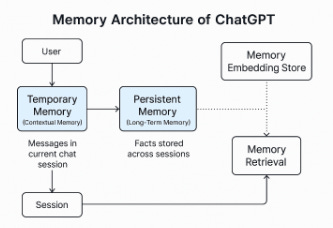
The memory system in ChatGPT—as of 2024 and into 2025—is designed to balance contextual awareness with user privacy and performance. Here's an overview of its architecture and how it works:
Two Types of Memory: Temporary vs. Persistent
a. Temporary Memory (Contextual Memory)
Scope: Limited to the current chat session.
Function: ChatGPT can remember messages from earlier in the session to maintain context, tone, and continuity.
Limit: Bounded by a context window (measured in tokens; e.g., GPT-4-turbo supports up to 128k tokens).
No storage after the session ends.
b. Persistent Memory (Long-Term Memory)
Scope: Carries across sessions (if enabled).
Function: Stores key facts you’ve shared (e.g., name, preferences, projects).
Example: “You’re Gene, and you run AIToolboard.com and audiocast.ai.”
Controlled by you: You can view, delete, or turn memory on/off from settings.
Architecture Breakdown
a. Session-Level State
Maintained in RAM during a single chat.
Messages are stored in a sequence and referenced as needed (with token trimming when near the context limit).
b. Memory Embedding Store (for Persistent Memory)
Facts or memory entries are converted into semantic embeddings.
Stored in a vector database or similar structure.
Enables fast retrieval of relevant user-specific memories during prompts.
c. Memory Retrieval System
When a session starts, the model queries the memory store for relevant info.
Retrieved memories are injected as system-level instructions or prompt modifiers to guide response generation.
How It Works Internally
You say something like: “I run a newsletter called Voxstar Weekly.”
ChatGPT recognizes this as memory-worthy.
If memory is ON: It creates a semantic representation and stores it.
Next time you return: It preloads “You run a newsletter called Voxstar Weekly” into the prompt before answering.
You can modify/delete this memory later.
Privacy & Control
Viewable: You can access what it remembers via “Settings > Personalization > Memory.”
Editable: You can delete individual memories or all of them.
Optional: You are notified when memory is updated, and you can turn it off.
Comparison to RAG (Retrieval-Augmented Generation)
While RAG typically involves pulling from large external document databases (e.g., PDFs, websites), ChatGPT's memory is:
More user-specific.
Smaller in scale.
Designed for personal context, not massive factual retrieval.
📌 Summary
Component Purpose Scope Contextual Memory Maintain conversation flow Per session Persistent Memory Store facts across sessions Long-term (if on) Embedding Store Store vectorized facts Behind the scenes Retrieval Mechanism Pull relevant facts into prompt At session start
FAQ
What is the architecture of ChatGPT's memory system?
ChatGPT's memory system has short-term memory parts for conversations. It also has token limits and ways to keep and use information. This setup helps the AI talk like a pro.
What are the core functions and capabilities of ChatGPT's memory system?
ChatGPT's memory keeps track of what's been said, gets the context, and answers based on past talks. These main tasks help the AI be a good chat buddy.
How does ChatGPT retain and process contextual information during conversations?
ChatGPT keeps track of what's happening in a chat. This lets it have clear and on-point talks. It handles the flow and switches topics smoothly.
What are the limitations and constraints of ChatGPT's memory system?
ChatGPT's memory has limits, like token limits, which affect how long and complex chats can be. These limits impact how well the AI does and need workarounds.
How does ChatGPT manage memory within individual sessions?
ChatGPT tracks chat history and resets memory when needed. It also keeps data for a while. This affects privacy and the chat experience.
How can prompt engineering be used to optimize ChatGPT's memory usage?
Writing good prompts helps ChatGPT remember more and do better. It's a key way to make the AI's memory work better in different situations.
#ArtificialIntelligence #MachineLearning #DeepLearning #NeuralNetworks #ComputerVision #AI #DataScience #NaturalLanguageProcessing #BigData #Robotics #Automation #IntelligentSystems #CognitiveComputing #SmartTechnology #Analytics #Innovation #Industry40 #FutureTech #QuantumComputing #Iot #blog #x #twitter #genedarocha #voxstar #aitoolboard #voxstar.ai #writerplus.co